
Amazon Shifts Logistics Strategy by Replacing Grubhub with Uber Eats for US Prime
The e-commerce giant redefines its food delivery ecosystem by ending its partnership with Grubhub in favor of Uber Eats, impacting competition in the delivery sector.
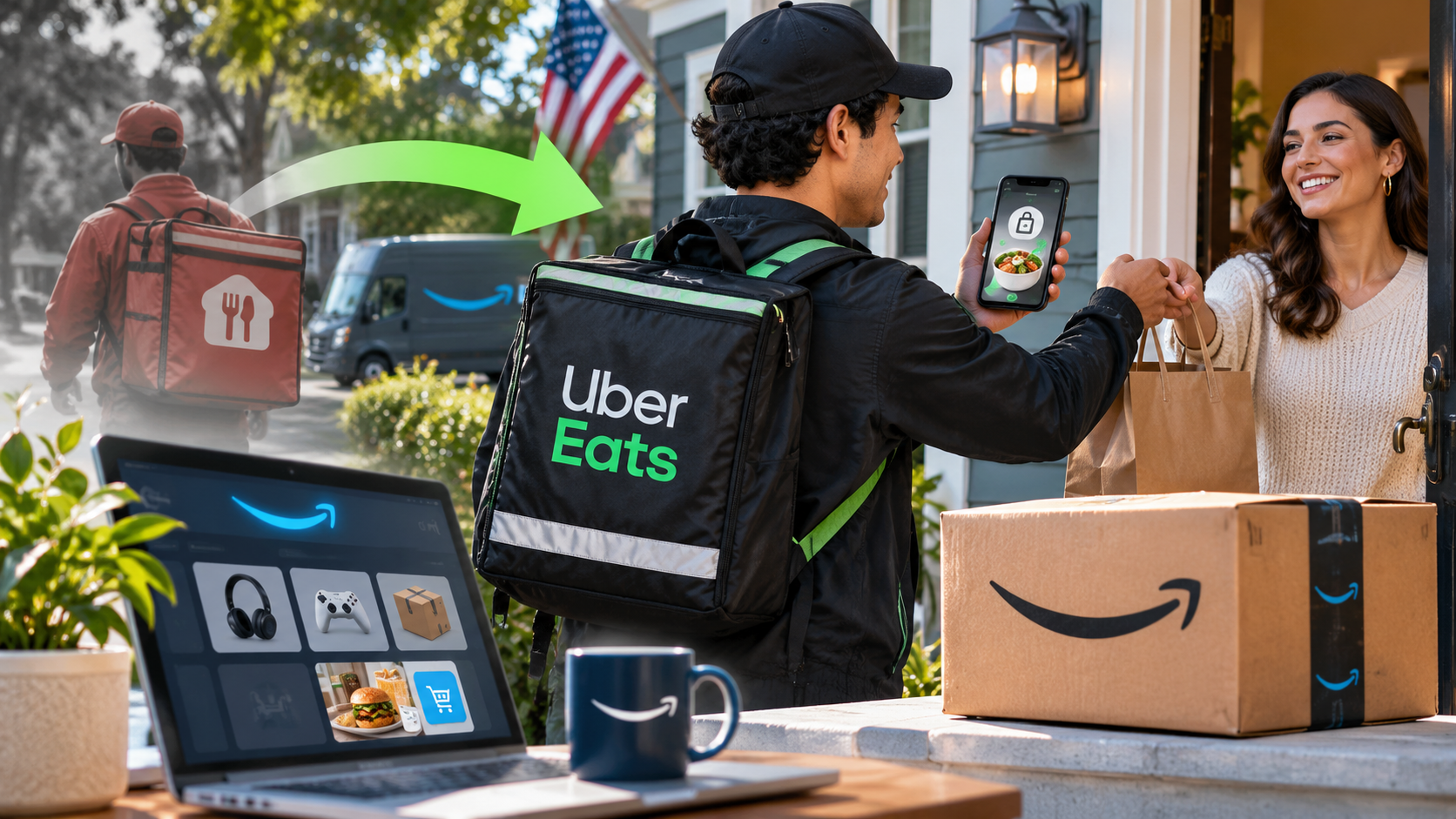
Illustration of the shift in Amazon Prime's food delivery strategy in the United States, highlighting Uber Eats and the previously maintained partnership with Grubhub.
The Story in 1 Minute
- Em anúncio oficial conjunto, a Amazon elegeu a Uber Eats como parceira oficial de delivery de restaurantes para membros do programa Prime nos Estados Unidos, encerrando o acordo anterior com a Grubhub.
- Gigante do e-commerce redefine seu ecossistema de serviços de entrega de alimentos ao encerrar parceria com a Grubhub em favor da Uber Eats, impactando a concorrência no setor de delivery.
- Acordo estratégico altera dinâmica concorrencial no setor.
In a significant strategic move for the delivery services sector, Amazon announced the termination of its partnership with Grubhub, establishing Uber Eats as the exclusive restaurant delivery service provider for Amazon Prime members in the United States. This transition marks a major shift in the benefits architecture of the Prime ecosystem, a central tool for Amazon to drive customer retention and customer lifetime value. The change reflects the company's ongoing reassessment of which partners best align with its operational scale and subscribers' convenience expectations.
For the market, the choice of Uber Eats is not trivial. The company possesses a vast and consolidated logistics infrastructure capable of meeting the capillarity demanded by the massive base of US Prime members. The exclusivity of this agreement places immediate competitive pressure on Grubhub, which loses a relevant distribution channel and potential order volume, while Uber Eats strengthens its position against rivals like DoorDash. The financial impact of this partner reallocation will be closely watched by Wall Street analysts, as agreements of this magnitude directly influence the recurring revenues of delivery services.
Context and Economic Scenario
The food delivery sector in the United States is going through a maturation phase, characterized by the relentless pursuit of profitability following a period of accelerated expansion financed by venture capital. Amazon's strategy in selecting partners for Prime has always aimed at increasing the program's 'sticky' factor. By swapping Grubhub for Uber Eats, Amazon appears to prioritize not only operational efficiency but also technological integration that allows for a frictionless user experience, a decisive factor in subscription churn rates.
Historically, partnerships between large e-commerce platforms and delivery companies face margin challenges. Last-mile logistics is inherently costly. For Uber Eats, integration with Amazon represents an opportunity to scale volume without the traditional total customer acquisition cost (CAC), since the Prime user base is vast and pre-existing. However, the success of this transition will depend on Uber's infrastructure capacity to absorb this additional demand without degrading service quality, a critical component for maintaining the perceived value of Prime.
From a macroeconomic and sectoral standpoint, this realignment highlights the ongoing consolidation of the delivery market. With operating margins pressured by labor and logistics cost inflation, the sector tends toward concentration in players with greater balance sheet resilience and technological capacity. Amazon's move is an indicator that logistical efficiency has become the primary competitive differentiator, surpassing the mere offer of temporary discounts or promotions.
How This Affects Your Pocket and Investors
For the end consumer in the US, the change implies an adaptation in the convenience ecosystem. Prime users should watch for updates to terms of service and potential changes in benefit offerings, such as delivery fees and restaurant availability. Centralizing the service on a single partner, Uber Eats, may result in greater service predictability, but reduces the diversity of platforms that previously made up Amazon's offering, requiring customers to monitor any price changes or hidden service costs.
For investors, the news should be analyzed from the perspective of market allocation and strategic partnerships. Uber Eats may record a positive impact on gross merchandise volume (GMV) processed, strengthening its operational metrics in the eyes of investors. Conversely, Grubhub faces a structural challenge to maintain its relevance in the US market, potentially seeing its market share eroded by this new Amazon exclusivity, which advises caution in evaluating these delivery companies' assets until the new dynamics stabilize in the next quarterly earnings report.
Developments and Next Steps
The market now awaits the first post-transition operational reports to verify the effectiveness of the technological integration between the Amazon Prime portal and the Uber Eats interface. The transition does not happen instantly and will depend on account migration phases and data flow adjustments between platforms.
Additionally, analysts will monitor whether Amazon seeks ways to more deeply integrate Uber Eats into its loyalty system, or if this partnership will serve merely as an offering component. Investors should pay attention to upcoming earnings calls from Uber and direct competitors to gauge the real impact of this move on market share and the financial health of the companies involved.
What this means for you
In a joint official announcement, Amazon has chosen Uber Eats as the official restaurant delivery partner for Prime members in the United States, ending its previous agreement with Grubhub.
This contextual analysis is strictly educational and informational regarding macroeconomic trends. It does not constitute investment advice.
This story was originally investigated and reported in Brazil. Numerical figures and data remain preserved in their official units.