
OpenAI Launches BioBasicsBench to Evaluate AI Agents in Laboratory Sciences
OpenAI's new tool measures the ability of autonomous agents to interpret raw experimental data and execute scientific tasks.
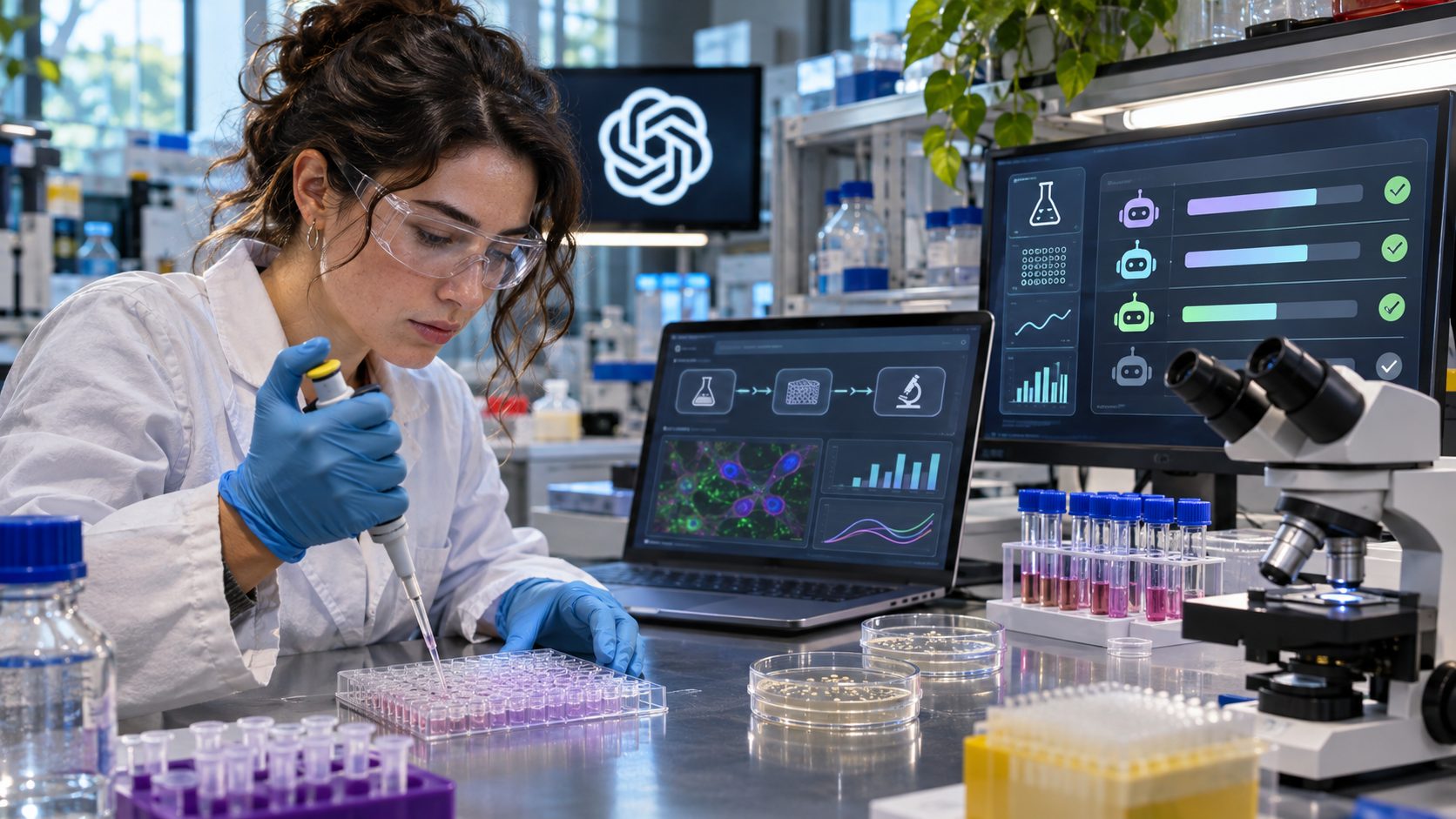
OpenAI presents BioBasicsBench to evaluate AI agent performance in lab scientific tasks.
The Story in 1 Minute
- OpenAI introduced BioBasicsBench, a 100-task benchmark designed to test AI agents in laboratory sciences, focusing on raw data interpretation and complex scientific workflows. This tool addresses the demand for high precision in biotech and pharma, potentially accelerating research and development while impacting industry investments.
OpenAI has officially announced the launch of BioBasicsBench, a benchmark structured with 100 specific tasks to evaluate the performance of autonomous artificial intelligence agents in traditional laboratory environments, known as wet-labs. The tool was developed to precisely measure the ability of these systems to interpret raw experimental data and handle everyday scientific protocols, marking an advance in testing methodologies for models focused on the biotechnology and pharmaceutical sectors.
The introduction of this benchmark reflects the expansion of tech companies' focus toward scientific applications of high analytical rigor, where data precision and experiment reproducibility are crucial. By testing agents in scenarios that simulate practical laboratory work, the initiative seeks to establish standardized benchmarks to evaluate the potential for automation in research and development, directly impacting the global ecosystem of innovation and technology investments.
Context and Economic Scenario
The advancement of generative artificial intelligence models and autonomous agents has demanded the development of more complex evaluative frameworks than traditional natural language tests. Sectors such as pharmaceuticals and biotechnology demand high mathematical and logical precision, reducing the margin for hallucinations in computational models. The creation of specialized benchmarks like BioBasicsBench is part of a context of strong competition for venture capital and corporate investment in R&D, with companies seeking to validate the technical reliability of their tools before applying them in regulated industrial environments.
The race to develop agents capable of executing complex scientific tasks also brings regulatory, cybersecurity, and biological safety implications. Governments and multilateral bodies closely monitor the integration of autonomous systems in laboratories, evaluating risks associated with handling sensitive data and validating experimental protocols. Rigorous measurement of the performance of these technologies is a fundamental prerequisite to mitigate operational risks and ensure compliance with international scientific standards.
How This Affects Your Wallet and Investors
For technology and healthcare sector investors, the advancement of agents focused on laboratory sciences signals a new frontier of efficiency and cost reduction in research and development. The automation of analytical steps in drug discovery and biotechnological processes can compress the time needed for the development of new products, influencing valuation and capex allocation of large technology and pharmaceutical companies listed on global markets.
On the other hand, the impact on the final consumer and the labor market occurs indirectly, through the transformation of production processes in high-tech industries. Scientific and technological professionals are coming to realize that the adoption of advanced AI tools will require new analytical skills, while the financial market continuously reassesses the risks and returns associated with heavy investments in artificial intelligence infrastructure.
Developments and Next Steps
The coming months are expected to be marked by the publication of comparative results using BioBasicsBench by independent researchers and developers. The scientific community will evaluate the actual effectiveness of the agents against the challenges proposed by the 100 tasks of the benchmark, providing crucial data on current technological maturity.
Meanwhile, regulators and companies will continue to debate the ethical and operational limits for the integration of autonomous systems in physical laboratories, establishing guidelines that will shape the pace of commercial adoption of these innovations in global markets.
What this means for you
The scientific community will evaluate the actual effectiveness of the agents against the challenges proposed by the 100 tasks of the benchmark, providing crucial data on current technological maturity.
This contextual analysis is strictly educational and informational regarding macroeconomic trends. It does not constitute investment advice.
This story was originally investigated and reported in Brazil. Numerical figures and data remain preserved in their official units.