
Brazilian Industrial Production Falls 0.8% in September: Warning Signs for the Real Economy
Data from the PIM-PF reveals the persistence of low industrial dynamism, keeping the year-to-date variation at a modest 0.4%.
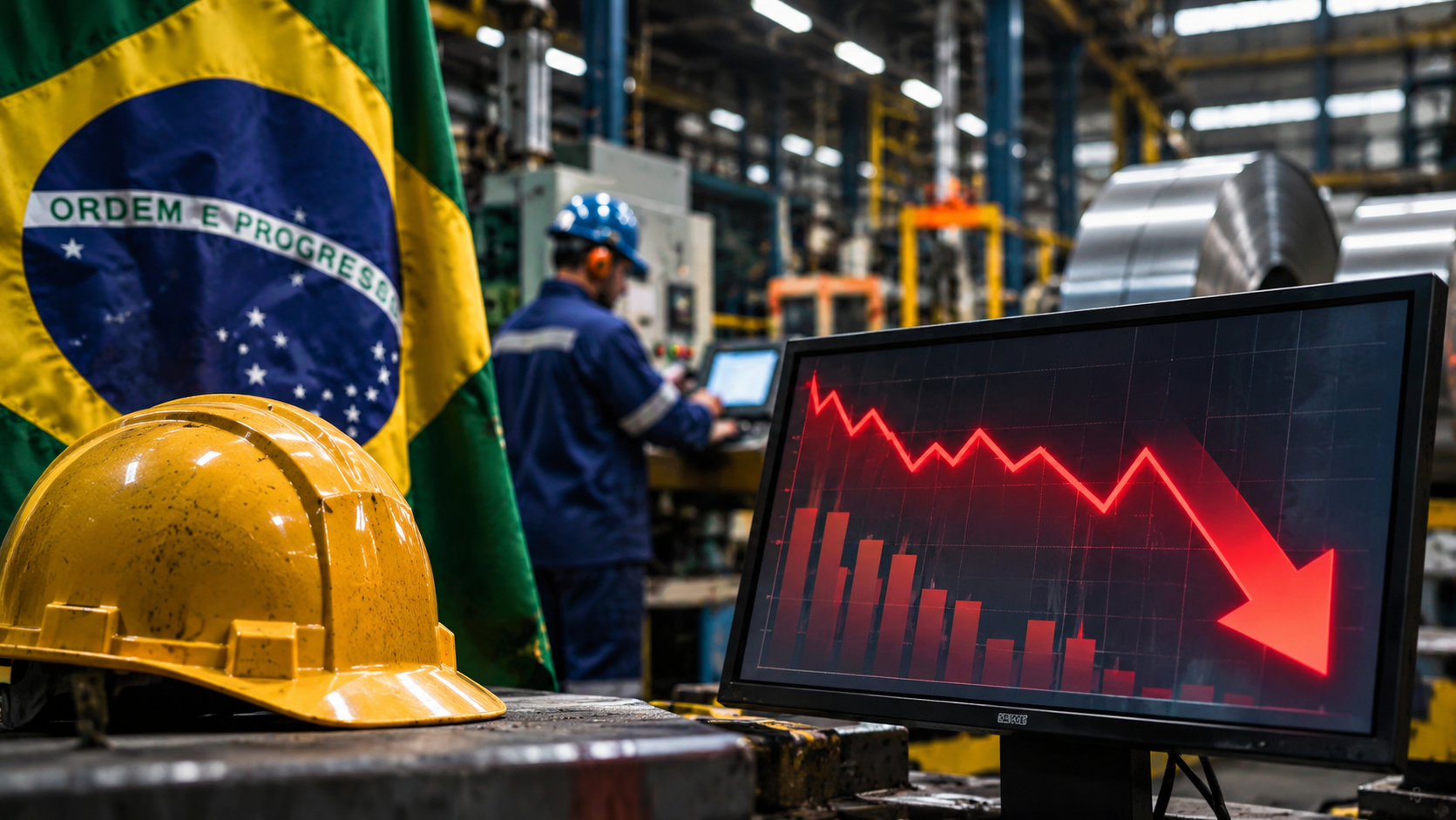
Brazilian industrial production records a 0.8% drop in September, sounding an alert regarding the performance of the real economy and the challenges faced by the productive sector.
The Story in 1 Minute
- A produção industrial brasileira registrou queda de 0,8% em setembro na comparação com agosto, refletindo um comportamento de estagnação que persiste desde o segundo trimestre.
- Dados da PIM-PF revelam a persistência de um cenário de baixo dinamismo industrial, mantendo a variação acumulada no ano em patamar modesto de 0,4%.
- Impacto relevante sobre infraestrutura econômica e produtiva.
The Monthly Industrial Survey (PIM-PF), released by the Brazilian Institute of Geography and Statistics (IBGE), indicates a contraction of 0.8% in Brazilian industrial production in September 2026, when compared to the immediately preceding month. This result halts expectations for a more robust recovery and consolidates a trend observed since May, characterized by the predominance of negative or neutral results. With this monthly performance, the index accumulated for the year 2026 reaches a rise of only 0.4%, data that highlights the manufacturing sector's difficulty in finding a sustained growth rhythm.
The behavior of the industrial sector, historically a thermometer for long-term economic health, reflects a complex interaction of macroeconomic variables. The September retraction is not an isolated event, but part of a sequence of results demonstrating the fragility of activity. Experts point out that the combination of a contractionary monetary policy cycle, designed to control inflationary pressures, has exerted a direct impact on the cost of capital and companies' willingness to invest in productive capacity and inventories.
Context and Economic Scenario
The 2026 scenario has been marked by an alternation between expectations of resilience and the confirmation of an economy in 'wait-and-see' mode. The manufacturing industry, in particular, faces the chronic challenge of lost competitiveness and volatility in the prices of commodities and imported inputs. When interest rates remain elevated, the ripple effect is immediate: consumer credit becomes more expensive, reducing demand for durable goods, while the cost of financing for companies' working capital inhibits expansion plans.
Beyond monetary factors, the Brazilian productive structure demonstrates vulnerabilities in energy- and technology-intensive sectors, where operating margins are pressured by logistical and regulatory bottlenecks. The analysis of September's data suggests that companies are prioritizing liability management and operational efficiency to the detriment of new capital expenditure (capex) projects. This phenomenon of "involuntary deleveraging" could prolong the period of low dynamism if there is no relief in financial conditions or a structural boost via productivity.
Additionally, the labor market and the level of household income, while maintaining notable resilience, have not been sufficient to sustain continuous expansion of industrial demand in the face of debt costs. The divergence between the services sector, which often supports GDP, and the industrial sector, which shows greater sensitivity to interest rates, creates a two-speed economy that challenges economic policymakers in Brasília.
How this affects your pocketbook and investors
For the investor, the data reinforces the need for caution in the allocation of cyclical assets. Companies exposed to the industrial sector depend directly on the future interest rate curve; weaker production results indicate operating margins under pressure, which can impact earnings per share (EPS) and, consequently, stock valuations. Analysts' recommendation has been to focus on companies with high cash flow, lower debt, and the ability to pass on price increases, mitigating risks in a scenario of unstable demand.
For citizens, the reflection of this data is indirect but persistent: an industry that does not grow is, historically, an industry that generates fewer qualified jobs and contributes less to GDP growth. When production retreats, the potential for an increase in the population's real income becomes more limited, as the industrial sector possesses one of the highest economic multipliers. Industrial stagnation also maintains pressure on relative prices, influencing the perception of the cost of living in the medium term.
Developments and Next Steps
The financial market now turns its eyes to upcoming inflation indicators and the minutes from the Monetary Policy Committee (Copom), looking for signs regarding the interest rate cycle. The expectation is that the government and the Central Bank will reassess the balance of risks between economic activity and the inflation target. The industry's performance in the final months of 2026 will serve as the basis for annual GDP projections, and any sign of recovery will essentially depend on the stabilization of household consumption and greater predictability in the cost of credit.
What this means for you
The decline reflects a struggle in the manufacturing sector due to high interest rates, which increase costs for companies and consumers. It suggests that without a change in monetary policy or improved productivity, the industrial sector will continue to exert a drag on overall economic growth for the rest of the year.
This contextual analysis is strictly educational and informational regarding macroeconomic trends. It does not constitute investment advice.
This story was originally investigated and reported in Brazil. Numerical figures and data remain preserved in their official units.