
99 Owner and Uber Report Negligible Volume of AI-Requested Rides
Urban mobility giants point to minimal adoption of autonomous artificial intelligence agents across their global platforms.
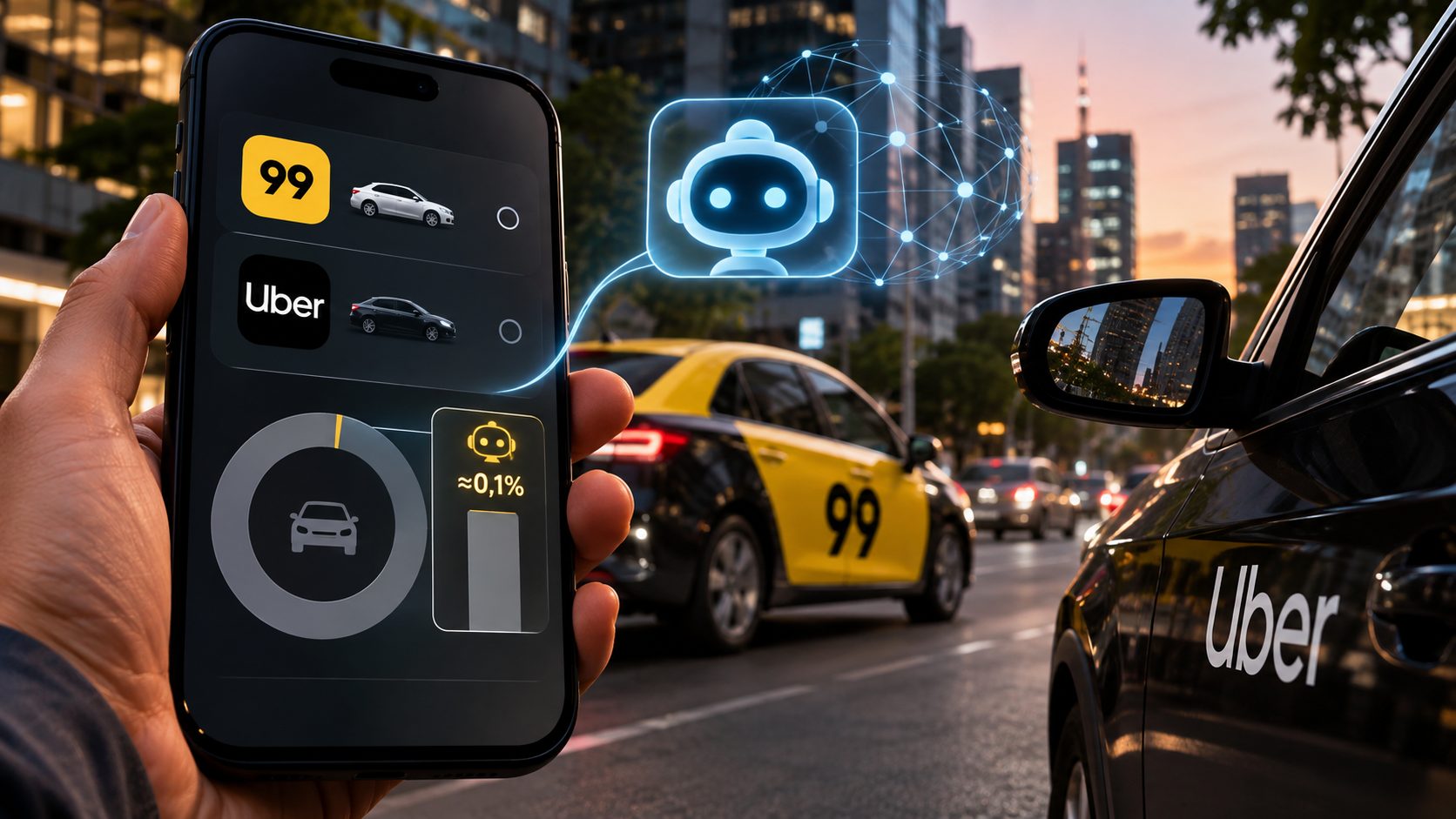
Uber and 99's owner register low share of ride requests made by artificial intelligence agents.
The Story in 1 Minute
- Urban mobility giants Uber and the owner of 99 have reported a negligible volume of rides requested by autonomous artificial intelligence agents. Despite massive investments in AI and automation, consumer adoption remains extremely low, highlighting a gap between corporate expectations and transactional reality. This sluggish adoption prompts investors and tech companies to reassess timelines and capital allocation for autonomous features.
The technological transition aimed at automating everyday services through artificial intelligence has encountered significant barriers in the urban mobility sector. Recently released data indicates that the owner of 99 and global giant Uber recorded a considered insignificant volume of trips requested by autonomous AI agents. While Uber reported only four trips originated by artificial intelligence systems during its evaluation week, 99's parent company confirmed an equally irrelevant level of such automated interactions.
The discrepancy between the advancement of generative models and their practical application in the transportation ecosystem raises important debates about operational maturity and real market demand for fully autonomous assistants. Companies in the sector invest hundreds of millions of dollars in digital infrastructure and advanced algorithms, but the conversion of these technologies into tools for daily use by the final consumer still moves at a slow pace. The integration of APIs through intelligent agents runs into usability frictions, data security, and users' preference for traditional interfaces.
Context and Economic Scenario
The technology and mobility ecosystem is undergoing a moment of intense scrutiny regarding the financial return on its investments in artificial intelligence, the so-called AI capex. Global technology sector giants have been allocating massive resources to develop autonomous capabilities, promising to revolutionize how consumers interact with digital services. However, the modest numbers released by platforms like Uber and 99's parent company demonstrate that the mass adoption of autonomous agents still faces a chasm between corporate theory and transactional reality.
From a macroeconomic point of view, skepticism regarding the speed of monetization of these innovations affects the risk assessment of market investors. Investors seek concrete validations that generative AI tools and autonomous agents will generate recurring revenues and measurable operational efficiencies. When empirical data reveals almost zero usage of highly promoted functionalities, the market reassesses the maturation timeframes of these technologies, pondering whether development costs align with actual user demand.
How This Affects Your Pocket and Investors
For the technology investor, the sluggishness in adopting autonomous agents serves as an important warning against inflated expectations regarding the growth pace of big tech companies. The market valuation of these firms often incorporates aggressive disruption premises that may not materialize in the short term, increasing stock volatility and requiring greater rigor in analyzing ROI (return on investment). Excessive focus on innovations that do not yet generate commercial traction can pressure operational margins without the counterpoint of new revenues.
For the final consumer and urban mobility app user, the immediate impact is neutral, as the experience of requesting trips via conventional apps remains unchanged. The absence of efficient autonomous agents in daily life means transportation decisions will continue to depend on direct human interaction and the platforms' traditional routing and pricing algorithms, without drastic disruptions in fares or vehicle availability.
Developments and Next Steps
Companies in the sector continue to refine their interfaces and test integrations with artificial intelligence systems, although recent data imposes a strategy review regarding the prioritization of autonomous agents for the final consumer. What is confirmed is that the technology still lacks large-scale validation for complex commercial transactions in the transportation sector.
In the coming months, the market will closely monitor the financial and operational reports of major technology companies to verify whether there will be adjustments in contributions directed at autonomous assistants or if efforts will be redirected to areas with proven higher return, such as fleet efficiency and internal server optimization.
What this means for you
Global technology sector giants have been allocating massive resources to develop autonomous capabilities, promising to revolutionize how consumers interact with digital services.
This contextual analysis is strictly educational and informational regarding macroeconomic trends. It does not constitute investment advice.
This story was originally investigated and reported in Brazil. Numerical figures and data remain preserved in their official units.