
Historic Crisis in Paraguay: President Resigns Following Ueno Bank Collapse and Impeachment Pressure
Intervention in a bank with nearly 3 million customers sparks protests, paralyzes financial services, and triggers a political crisis in the country.
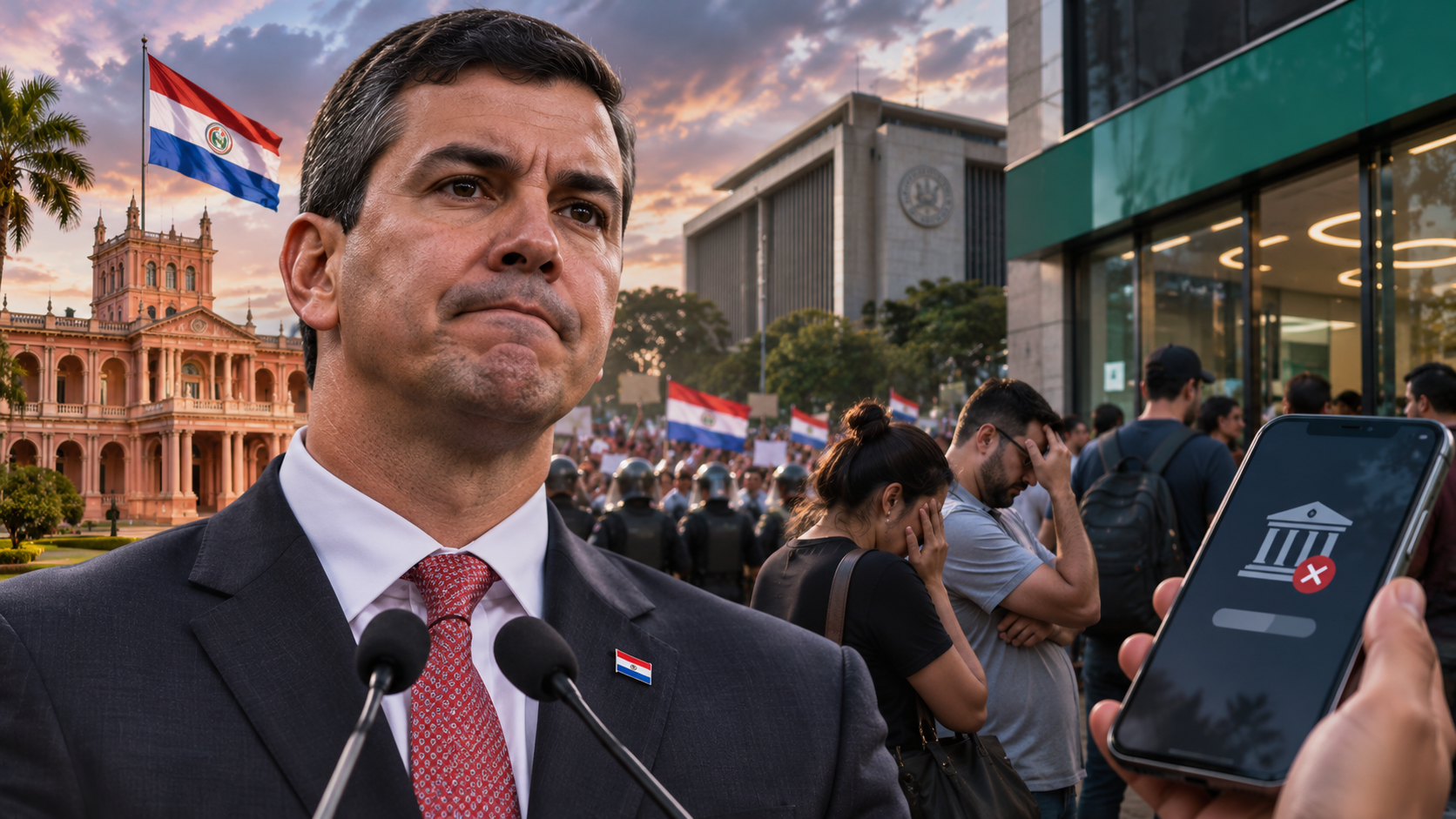
Banking crisis in Paraguay triggers the resignation of Santiago Peña. Illustrative image.
The Story in 1 Minute
- O presidente do Paraguai, Santiago Peña, apresentou sua renúncia nesta quinta-feira (5), em meio à crise provocada pela intervenção no Ueno Bank.
- O Banco Central do Paraguai colocou o Ueno Bank em resolução após problemas de solvência.
- Santiago Peña renunciou sob pressão política, enquanto o Congresso discute os passos da sucessão.
Paraguay is facing one of the most severe political and financial crises in its recent history following the collapse of Ueno Bank, a digital institution that served approximately 3 million customers. On Thursday (5), President Santiago Peña announced his resignation in the face of public and parliamentary pressure caused by the intervention of the Central Bank of Paraguay (BCP). The scandal, which involves public funds, suspicions of financial irregularities, and the president's past business ties with the bank's controlling group, sparked protests and led the Chamber of Deputies to vote 78 to 0 to advance impeachment proceedings. The crisis calls into question the institutional stability of a country that had been consolidating its image as an attractive investment destination in South America.
This episode surpassed the limits of the banking sector and took on a national dimension. With apps, cards, and transfers affected, millions of customers faced difficulties accessing their funds, while companies and public entities began monitoring the risks associated with the institution. According to international media reports, the bank managed approximately US$ 850 million in public deposits, including funds linked to social security and health. The deterioration of confidence in the financial system increased scrutiny on regulatory bodies and the government. Although Peña announced his departure, institutional developments still depended on decisions by Congress, with Vice President Pedro Alliana pointed out as the constitutional successor to complete the term until August 2028.
The Ueno Bank Collapse and the Origin of the Crisis
The financial crisis gained momentum after the Central Bank of Paraguay announced on November 3 the start of Ueno Bank's resolution procedure, approved by the monetary authority the previous day. According to the BCP, adjustments to financial statements revealed that the institution's solvency ratio had fallen to less than 50% of the minimum required by law. This indicator measures a bank's ability to maintain sufficient capital to absorb losses and sustain its operations. Faced with the deterioration of its equity, the monetary authority initiated measures to preserve assets, protect depositors, and organize the handling of financial obligations. The rapid expansion of the digital bank, which captured an exceptionally large customer base for the size of the Paraguayan population, increased the economic and social scale of the problem.
Taking on political contours due to Santiago Peña's previous business ties with Grupo Vázquez, related to Ueno Bank, the situation intensified. According to Reuters, the president held equity participation in the group until March 2025. The revelation intensified questions about conflicts of interest, financial oversight, and the use of public funds, although the existence of this tie does not, on its own, prove involvement in irregularities. Amid protests and the loss of political support, Peña announced his resignation, citing the need to preserve national stability. The Chamber advanced the impeachment despite the announcement, amplifying the institutional crisis and transferring part of the decisions regarding its next steps to the Senate.
Financial Impact and Depositor Protection
The main immediate challenge for Paraguayan authorities is to restore customer confidence and guarantee access to deposits protected by law. The Paraguayan Deposit Guarantee Fund provides coverage of up to 75 monthly minimum wages, equivalent to approximately 228.3 million guaranis per depositor and per financial institution, according to BCP information. However, this limit does not mean that all amounts are made available immediately. In a statement published on Thursday (5), the Central Bank announced the start of payments for a first category of customers with deposits of up to 10 million guaranis, subject to conditions established by the authority. The return of funds is expected to take place in stages, while the resolution process seeks to manage available assets and administer the bank's obligations.
For the financial market, concern goes beyond the losses of a single institution. Banks depend directly on depositor confidence, and prolonged interruptions in access to money can affect payments, consumption, working capital, and investment decisions. The presence of public funds in Ueno Bank increases the need for transparency regarding the recovery of amounts and potential responsibilities. Despite the severity of the episode, the Central Bank of Paraguay states that the situation is specific to the institution and does not represent a generalized deterioration of the national banking system. The ability to fulfill the announced payments and present clear information will be decisive in reducing contagion risk and preserving financial stability.
How the Crisis May Affect Brazil and Investors
Paraguay had been strengthening its position as an investment alternative in South America, driven by factors such as competitive taxation, relatively low operating costs, and commercial proximity to Brazil. The combination of a far-reaching banking crisis and the announced departure of the president introduces new uncertainties regarding the institutional and regulatory environment. For Brazilian companies with operations in the country, especially those using local financial institutions to move funds, the episode reinforces the need to assess banking exposure, liquidity availability, and the continuity of payment methods. Investors will also need to monitor potential changes in political risk perception, which can influence expansion, financing, and capital allocation decisions.
From a macroeconomic standpoint, the crisis represents an important test for the credibility of Paraguayan institutions. The reputation for stability built over recent years depends not only on fiscal and monetary indicators, but also on supervisory capacity, legal certainty, and the response to extraordinary situations. If authorities manage to protect depositors, clarify irregularities, and conduct the presidential succession in an orderly manner, the impacts may remain relatively concentrated. On the other hand, prolonged delays in deposit recovery, new governance problems, or institutional disputes could increase investor caution. This does not mean Paraguay has ceased to be a viable business destination, but rather that the episode demands a more careful assessment of risks.
Developments and Next Steps
The scenario remains evolving, with different fronts of investigation and institutional decisions still pending. In the financial sector, attention is focused on executing depositor guarantees, identifying equity losses, and the destination of public funds held in Ueno Bank. Authorities must also clarify any irregularities related to credit granting, asset management, and the institution's governance. In the political sphere, Congress will play a decisive role in formalizing the presidential transition and addressing the responsibilities discussed during the impeachment process. The confirmation of new facts or decisions could rapidly alter the assessment of the crisis's severity and duration.
For investors, business owners, and citizens with financial ties to Paraguay, monitoring official Central Bank statements and Legislative decisions will be essential in the coming weeks. The evolution of payments, the transparency of investigations, and the operational continuity of other banking institutions will serve as important indicators of the country's recovery capacity. More than an isolated crisis, the episode highlights how financial governance vulnerabilities can trigger far-reaching political and economic consequences. The Paraguayan challenge will be to demonstrate that its institutions can manage the crisis, protect citizens, and rebuild the confidence necessary to sustain economic growth.
What this means for you
For Brazilians with money, suppliers, or operations in Paraguay, the most useful step is to review concentration in a single institution, maintain operational liquidity outside the affected bank, and monitor official statements from the Central Bank of Paraguay. The crisis does not warrant concluding that the entire banking system has collapsed, but it demands greater diligence until account transfers and loss assessments become clear.
This contextual analysis is strictly educational and informational regarding macroeconomic trends. It does not constitute investment advice.
Verified Sources & Editorial Transparency
This report was prepared by Lumin Finanças News following journalistic coverage by the outlets listed below, with cross-checked information from original entities:
This story was originally investigated and reported in Brazil. Numerical figures and data remain preserved in their official units.